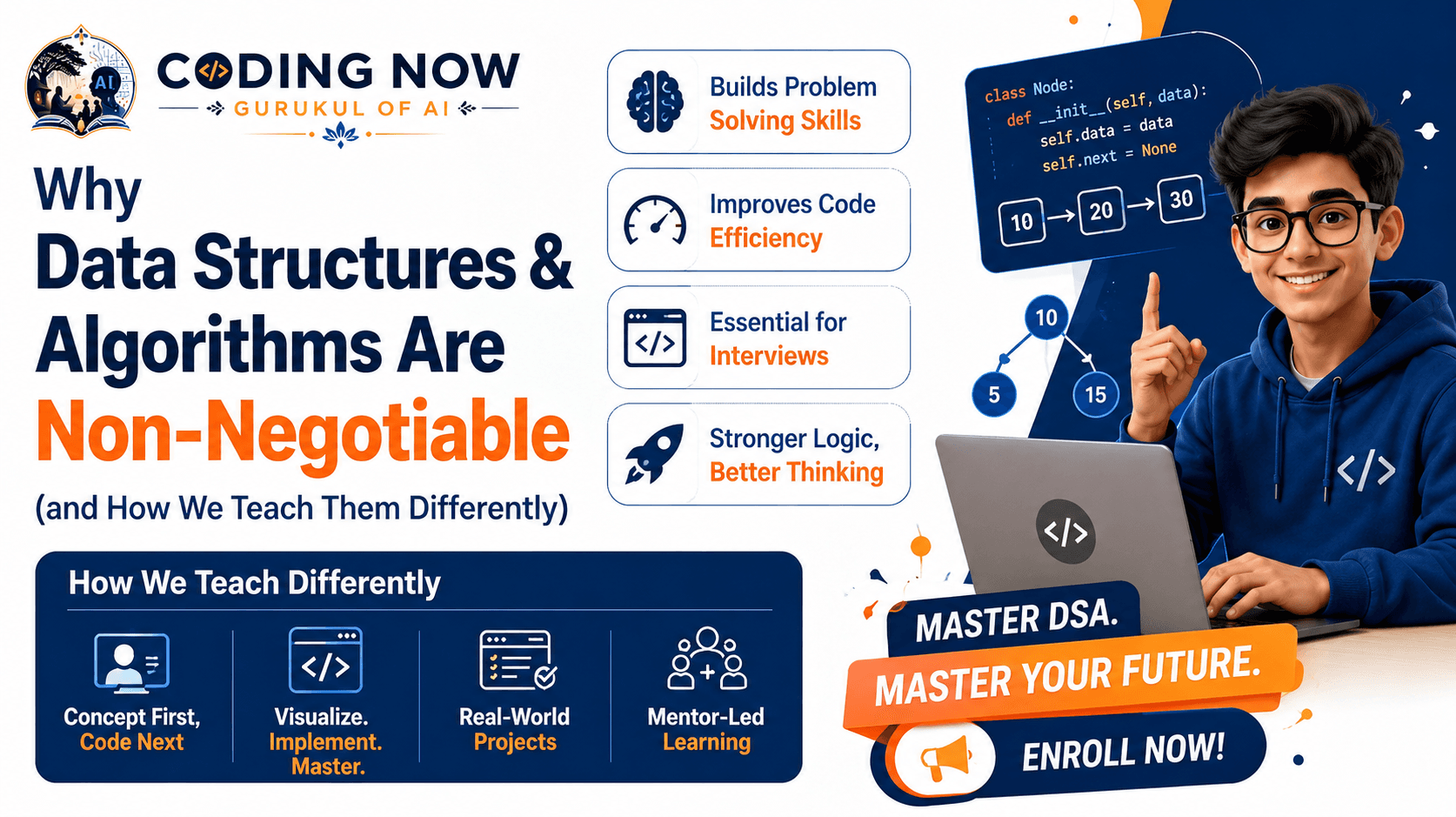
The Hard Truth About Cracking Tech Interviews
You have learned Python. You have built a few web pages. You can even write a basic API. So why do so many talented programmers still fail technical interviews at companies like Amazon, Google, or Infosys?
The answer is simple but brutal: They never mastered Data Structures & Algorithms (DSA).
At CodingNow – Gurukul of AI, we do not hide this truth from our students. DSA is not an "optional advanced topic." It is the non-negotiable foundation of every successful tech career. Whether you want to be a Full Stack Developer, AI Engineer, or Data Scientist — if you cannot solve problems efficiently, you will not get hired.
But here is the good news: DSA is not rocket science. It is a skill — and like any skill, it can be learned with the right teaching method.
Why DSA Is Non-Negotiable (Even for Web Developers)
1. It Separates Coders from Problem-Solvers
Anyone can copy-paste code from Stack Overflow. But when your app needs to handle 1 million users, your O(n²) bubble sort will crash. A developer who understands time complexity and space complexity writes code that scales.
2. It Is the Universal Language of Tech Interviews
Whether you apply at a startup or a FAANG company, the first two rounds will be DSA problems:
- "Reverse a linked list."
- "Find the shortest path in a grid."
- "Design a cache using a hash map."
Without DSA, you will not even reach the system design round.
3. It Makes You a Better Engineer in Any Domain
- AI/ML: Algorithms like gradient descent, decision trees, and search algorithms are pure DSA.
- Full Stack: Efficient data fetching, caching strategies, and API rate limiting all require algorithmic thinking.
- Cloud Computing: Load balancing, distributed systems, and database indexing are built on DSA principles.
How Most Institutes Teach DSA (And Why It Fails)
Traditional coaching centers make three critical mistakes:
- ❌ Theory-Heavy, Code-Light: They spend weeks on pseudocode and diagrams. Students never actually implement a red-black tree or a graph traversal.
- ❌ No Real-World Context: "Why do I need to learn a stack?" — A fair question. Without answering it, students lose motivation.
- ❌ No Interview Simulation: Students learn DSA in isolation but have never solved a problem under a 30-minute timer with someone watching.
The result? Students memorize solutions instead of building problem-solving instincts.
The CodingNow Gurukul Way: How We Teach DSA Differently
Pillar 1: Learn by Building, Not Memorizing
We do not start with theory. We start with a problem.
Example: "You are building a browser's back button. What data structure would you use?"
Then you implement a stack from scratch. You see the problem. You feel the need. Then you learn the solution.
Every DSA topic is introduced through a real-world scenario:
- Arrays → Managing a leaderboard
- Queues → Handling print spooler or message broker
- Hash Maps → Building a phonebook or cache
- Trees → Representing a file system or HTML DOM
- Graphs → Finding the shortest route on Google Maps
- Dynamic Programming → Optimizing a delivery route
Pillar 2: Live Coding & Pair Programming
Every DSA class at CodingNow is live and interactive. You do not watch pre-recorded videos. You code alongside your mentor in real-time.
- Mentor writes code — you see their screen.
- You write the same code — they see your screen.
- You solve a variation — they guide you through debugging.
Our small batch sizes (maximum 15-20 students) ensure that every student gets personal attention.
Pillar 3: Weekly Coding Battles & Mock Interviews
Every week at CodingNow:
- Coding Battles: Timed challenges where you compete with classmates on platforms like LeetCode and HackerRank.
- Peer Code Reviews: You review someone else's solution. Someone reviews yours. You learn 10x faster.
- Mock Technical Interviews: Live DSA interviews with direct feedback on your approach, communication, and optimization.
By the time you finish our DSA module, you will have solved 150+ coding problems and appeared in 5+ mock interviews.
The DSA Roadmap We Follow
| Phase | Topics Covered | Real-World Application |
|---|---|---|
| Phase 1 (Weeks 1-2) | Complexity analysis, recursion, basic loops | Optimizing a slow search function |
| Phase 2 (Weeks 3-5) | Arrays, linked lists, stacks, queues | Browser history, undo/redo, task scheduler |
| Phase 3 (Weeks 6-8) | Hash maps, trees, BSTs, heaps | Cache implementation, autocomplete, priority queue |
| Phase 4 (Weeks 9-10) | Graphs, tries, segment trees | Social network connections, dictionary search |
| Phase 5 (Weeks 11-14) | Sorting, searching, BFS, DFS, Dijkstra, DP | Pathfinding, recommendation engines |
| Phase 6 (Weeks 15-16) | 150+ LeetCode problems, company-specific prep | Cracking Amazon, Google, TCS interviews |
Each phase ends with a mini-project that uses the data structures you just learned.
Real Results: From DSA Fear to ₹34 LPA Package
Our students have gone from DSA fear to cracking top companies. Our 100% placement support combined with DSA mastery has helped 3200+ students land jobs at Amazon, Cognizant, TCS, Infosys, Genpact, and 50+ other hiring partners.
DSA Is Not Just for Interviews. It Is for Life.
Even after you get the job, DSA will help you:
- Write faster database queries
- Optimize API response times
- Debug performance bottlenecks
- Design scalable systems
At CodingNow – Gurukul of AI, we do not train you for the first job. We train you for the next 20 years of your career.
🎁 Free Demo Class: Experience Our DSA Teaching Method
📌 In our free demo class, you will:
- Solve a real coding problem with a mentor live
- Understand how we connect DSA to real-world apps
- See our small batch size and interactive teaching in action
- Talk to current students about their DSA journey
📞 Call/WhatsApp: +91-9667708830 | Visit: codingnow.in | Pitampura Center (Near Metro, Delhi)
